Running signage across dozens or hundreds of stores teaches you one thing fast: the right digital signage platforms for retail are the ones that handle location-based content, security, and integrations at scale without buckling. Features win demos. Operations win deployments. What follows are seven lessons from managing multi-location content in the real world, each one earned the hard way. Read them before you sign a contract, not after.
Lesson 1: The best platform is the one your team can actually run
The best digital signage platform for enterprise retailers, and for retail communications teams in particular, is the one your team can operate daily at scale. Not the one with the longest feature list. Prioritize central control, reliability, and fit with the systems you already run.
Enterprise signage solutions live or die on operability. A platform that dazzles in a demo but takes three specialists to run will stall the moment you roll it out to 200 stores. The teams that succeed pick for the unglamorous things: clear workflows, dependable uptime, and a support team that actually answers.
Use a simple evaluation checklist when you compare digital signage platforms for retail:
- Central control with local flexibility.
- Location-based scheduling and targeting.
- Role-based access and approval workflows.
- Signage security and remote device management.
- Open APIs and app integrations.
- Network uptime backed by a written SLA.
- Onboarding and ongoing support.
Score every option against those seven. The winner is rarely the flashiest. It is the one your team will still be running smoothly a year in. That is what separates real enterprise signage solutions from software that only looks the part.
Quick Takeaway
The best digital signage platforms for retail are the ones your team can run at scale, not the ones with the longest feature list.
Location-based content should run on rules, not manual rekeying per store.
Signage security and role-based access are baselines, not add-ons.
App integrations decide your ceiling. Test the ones you actually need.
Scale exposes skipped fundamentals. Standardize early and weigh cost and vendor lock-in honestly.
Lesson 2: Location-based content is the real test 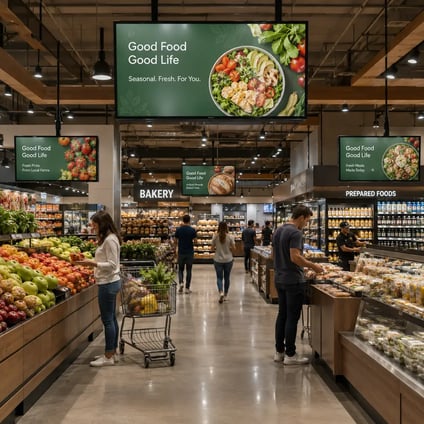
The platform that handles location-based content for many stores lets you target content by store, region, format, or daypart from a single cloud CMS. If you cannot vary content by location without manual work, the platform will not scale with you.
This is where most tools quietly fail. A national promo needs to run everywhere, but a store in Miami should not push a snow-boot campaign, and a west-coast location should not flip a schedule on east-coast time. Managing that by hand across a network is exactly how errors creep in.
Picture a spring sale rolling out to 300 stores overnight. Without location targeting, one region still shows last week's clearance, another flips the sale live a day early, and field teams spend the morning on the phone instead of the floor. That is not a content problem. It is a targeting problem, and it compounds with every store you add.
Strong location-based content means rules, not rekeying. Tag your stores by attribute, set targeting once, and let the platform deliver the right content to the right screens automatically. Cloud digital signage makes this practical at any footprint, because the logic lives centrally and the players just execute it.
Explore
Digital Signage Platforms for Retail
See how enterprise retailers run multi-location content from one cloud platform.
Explore retail solutionsLesson 3: Security is non-negotiable at scale
The digital signage platform that works best for secure retail deployments enforces device security, encrypted content delivery, and role-based access as defaults, not add-ons. At scale, every unmanaged screen is an attack surface.
Retail teams underestimate this until an incident forces the issue. A media player on the store network is a computer. Left unpatched or wide open, it becomes a way in. Signage security is not a feature you bolt on later. It is a baseline you demand up front.
Look for centrally managed device security, encrypted content delivery, single sign-on, and role-based access, so a regional manager cannot touch corporate brand assets. The best digital signage platforms for retail treat security as infrastructure, because a breach through a screen costs far more than the screen ever did.
Lesson 4: Judge platforms by customer engagement, not feature count
Retailers should compare digital signage platforms for customer engagement by how reliably they
deliver the right message to the right screen at the right moment, proven with playback and engagement data. A platform that cannot prove what played cannot prove it engaged.
Feature lists are easy to inflate. Outcomes are not. What actually drives retail customer engagement is consistency and relevance: the correct content, live on the correct screens, at the moment it matters. That takes dependable scheduling and honest reporting, not a longer menu of effects.
Ask every vendor how they measure and prove delivery. Proof-of-play, uptime reporting, and content performance data separate platforms that drive retail customer engagement from ones that merely display. If they cannot show you the data, assume there is none.
See it in action
The UPS Store Case Study
How a multi-location brand brought scattered signage under central control.
Read the case studyConsider two platforms that look identical on paper. One reports exactly which asset played on which screen and when. The other shrugs. When a regional director asks why a campaign underperformed, only one of those platforms can answer, and that answer is the difference between fixing the gap and guessing at it.
Lesson 5: App integrations decide your ceiling
The top cloud digital signage platforms with app integrations connect to your POS, product data, scheduling, and other systems through open APIs. Integrations are what turn static screens into live, data-driven content.
Here is the trap. A platform without solid app integrations forces manual updates forever. Prices change in the POS but not on the screen. Stock runs out, but the display still promotes it. That gap is where a network loses trust with shoppers, one wrong price at a time.
Real integration closes the loop automatically. Connect the CMS to your source systems and the screen reflects reality without anyone touching it. When you evaluate digital signage platforms for retail, test the app integrations you actually need, not the wall of connector logos you never will.
Lesson 6: Cloud digital signage is what large chains run
Large retail chains run cloud digital signage platforms for retail because only the cloud lets a central team manage thousands of screens, push updates instantly, and monitor uptime remotely. On-premise setups cannot match that reach or speed.
The math is simple. Sending a technician to every store to update content does not scale past a handful of locations. Cloud digital signage removes the travel and the lag entirely. One update, everywhere, in minutes.
That is also why the cloud wins on resilience. Central monitoring catches an offline player before a customer does, and content restores from the cloud without a site visit. When a player goes dark on a Friday night, a central admin repushes content from a laptop in minutes. Without that, the screen stays broken until Monday, when someone finally books a truck roll. Multiply that across a network,k and the cost of no monitoring is obvious. For any chain past a few dozen stores, cloud is not a preference. It is the requirement.
Lesson 7: Scale breaks on the fundamentals you skipped
Cloud digital signage platforms become hard to scale when the fundamentals are skipped: no naming conventions, no role structure, weak integrations, and no monitoring. Scale does not create these problems. It exposes them.
Every shortcut you take at 10 stores becomes a crisis at 500. A messy content library nobody can search. Permissions so loose that anyone can publish anything. Integrations held together with manual exports. None of it hurts much early. All of it compounds.
Be honest about the trade-offs, too. Cloud platforms carry ongoing cost, and switching later is painful, so vendor lock-in is a genuine risk. Scaling complexity is real. The way through is not to pretend these away but to plan for them: standardize early, integrate properly, and choose a platform whose pricing and data portability you can live with as you grow.
Vendor lock-in is the trap that shows up last and hurts most. A platform that is easy to get into and hard to get out of will quietly raise the cost of leaving every year. Before you commit, ask how you export your content, your schedules, and your data if you ever walk away. If the honest answer is that you cannot, price that risk in now.
Get the fundamentals right at small scale and growth is smooth. Skip them and the platform will not be the thing that breaks. Your process will.
Evaluate your signage platform against all seven lessons
Let us walk your network through the checklist and show you where the gaps are.
Talk to our teamYour next step
Start with the evaluation checklist. Score your current or prospective platform against the seven criteria in Lesson 1, and be ruthless about the gaps. The right digital signage platforms for retail are the ones that pass on operations, security, and integrations, not the ones that win the demo. Fix the fundamentals before you scale, and multi-location content stops being a fire drill and becomes a routine.

Brent Nacu
CRO at L Squared Digital
Brent Nacu is the Chief Revenue Officer at L Squared Digital, with 20+ years in digital signage. He helps organizations build display strategies that improve engagement, streamline operations, and drive real results.
LinkedIn