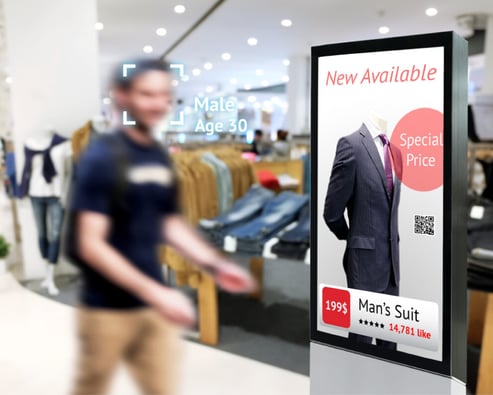
Choosing retail signage software should not feel like a gamble, but for most enterprise teams, it does. The market is crowded, the demos all look the same, and the real differences hide behind the sales deck. Here is the short version. The best digital signage platforms for secure, multi-location retail win on three things: security, centralized control, and location-based content delivery. Everything else is secondary. This guide walks retail and IT leaders through how to evaluate cloud-based signage on what actually matters, so you buy once and buy right.
Quick Takeaway
Judge digital signage platforms on three fundamentals: security, centralized control, and location-based content.
Treat every screen as a network endpoint. Demand encryption, SSO, role-based access, and central patching.
Centralized control with local flexibility keeps retail communications consistent across every store.
Score every option against a seven-point checklist before you take another demo.
Weigh the trade-offs honestly: cost, integration time, and vendor lock-in.
How to choose secure retail signage software
To choose secure retail signage software, evaluate platforms on three non-negotiables: enterprise- 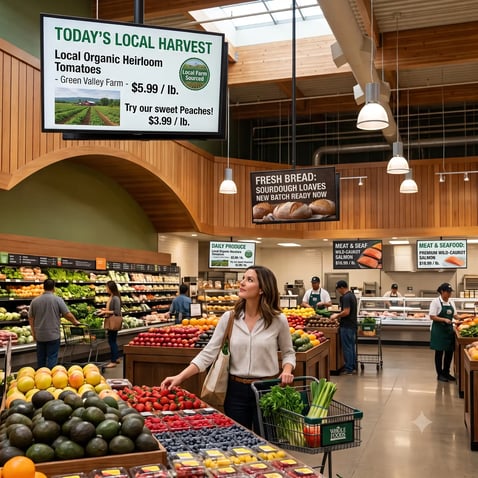 grade security, centralized control across every location, and built-in location-based content. A platform weak on any one of these will cost you later, no matter how sharp the demo looked.
Most buying mistakes come from judging by features instead of fundamentals. A long menu of transitions and templates means nothing if the platform cannot protect your network, hold consistency across stores, or target the right content to the right site. Start with the fundamentals, then let features break ties. When you shortlist digital signage software for retail stores, keep this order of priorities, and you will filter out the weak options fast.
The same logic applies whether you run a national chain or a regional group. A bigger footprint raises the stakes on security and control, but the evaluation order holds. Get the three fundamentals right, and the best digital signage platforms make themselves obvious. Get them wrong, and no feature list will save the rollout.
Explore
Digital Signage Platforms for Retail
See how enterprise retailers run secure, multi-location signage from one platform.
Explore retail solutionsSecurity first: what secure deployments require
Secure deployments start with treating every screen as part of your network, because that is exactly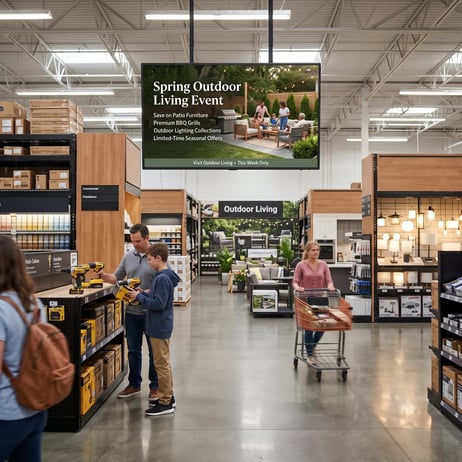 what it is. A media player sitting on the store network is a computer. If it cannot be patched, encrypted, and access-controlled from the center, it is a liability, not an asset.
Retail teams learn this the hard way. An unpatched player left open on a store network is a quiet door for an attacker, and one weak endpoint can expose the whole chain. Closing that door up front, rather than after an incident, is the whole point.
When you assess security on digital signage platforms, insist on the basics: encrypted content delivery, single sign-on, role-based access so a store manager cannot touch corporate assets, and centrally managed patching. It also helps when a platform runs on enterprise cloud infrastructure from a provider your IT team already trusts, because that inherits a security posture you do not have to build yourself. Security is not a feature you bolt on later. It is the foundation you buy on.
There is a compliance dimension too. Enterprise IT will ask who can access the platform, how changes are logged, and where content data lives. A platform with clear audit trails, granular permissions, and a known hosting footprint makes that conversation short. One without them turns a signage rollout into a security review that stalls for months.
See it in action
The UPS Store Case Study
How a franchise network deployed secure signage on Microsoft Azure and IoT, in minutes per store.
Read the case studyDemand centralized control for retail communications
Centralized control means one team can manage retail communications across every location from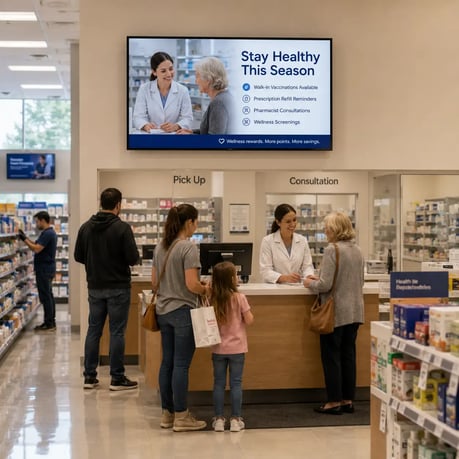 a single cloud platform, while local stores still handle what is genuinely local. If you cannot push a national update everywhere in minutes, the platform will not scale with your footprint.
Picture a brand-wide promotion that has to launch across 300 stores on the same morning. Without central control, that becomes a scramble of manual updates, missed screens, and inconsistent messaging that undercuts the brand. With it, the update ships once and lands everywhere, on time and on brand.
The strongest cloud-based signage keeps that balance: corporate owns brand content and compliance, regional teams manage local promotions within guardrails, and role-based permissions keep the two from colliding. That structure is what turns scattered screens into a coordinated retail communications network instead of a thousand independent problems.
Speed is the other payoff. When a price changes or a product is pulled, you cannot afford a slow rollout. Central control means the correction reaches every screen at once, which protects both the brand and the customer. That responsiveness is easy to overlook in a demo and impossible to ignore the day you need it.
See it in action
The Rogers Wireless Case Study
A national retail network that kept every location secure, on brand, and on message.
Read the case studyMake location-based content non-negotiable
Location-based content is the ability to target what plays by store, region, format, or daypart, automatically, without rekeying content per site. For any retailer past a handful of locations, this is the difference between a platform that scales and one that fights you.
The reason is simple. A downtown flagship and a suburban branch do not serve the same shopper, and a coastal store should not run a schedule set to the wrong time zone. Manual workarounds break down fast at scale. Real location targeting runs on rules and store attributes, so the right message reaches the right screen on its own.
Done well, this is also where retail customer engagement lives. Relevant, local, current content holds attention at the counter and in the aisle far better than generic corporate creative on repeat. This kind of targeting is not a nice-to-have. It is how a national brand stays locally relevant.
How to compare digital signage platforms: the evaluation checklist
The fastest way to compare digital signage platforms is to score every option against a fixed set of criteria, so you judge on evidence instead of the demo. When you shortlist the best cloud digital signage software for retail, run each candidate through these seven criteria:
- Security and compliance: encryption, single sign-on, role-based access, and centrally managed patching.
- Centralized control with local flexibility.
- Location-based targeting and scheduling.
- Reliable cloud infrastructure with uptime backed by a written SLA.
- Open APIs and integrations with your POS and data systems.
- Simple deployment and responsive support.
- Transparent pricing and clear data portability if you ever leave.
Score each platform one to five on every line. Be honest about the trade-offs, too. The most secure option may cost more, the deepest integrations may take longer to stand up, and every cloud contract carries some vendor lock-in. The goal is not a perfect score. It is a clear-eyed view of where each platform is strong and where you will have to compromise.
For enterprise and IT teams
Built on Microsoft Azure and IoT
Enterprise-grade security, centralized control, and location-based content, backed by a written SLA.
See how it scalesWeigh integrations and total cost of ownership
The best digital signage platforms do not live in isolation. They connect to the systems you already run, so the screen reflects reality without manual updates. Open APIs that tie into your POS, product data, and scheduling tools are what turn static displays into live content. A platform with no real integration path will quietly cost you in manual work forever, and that cost never shows up in the license fee.
Total cost of ownership is the other half of the picture, and it is bigger than the sticker price. Count hardware, installation, the staff time to run the platform, and the cost of training store teams. Then look hard at the exit. Every cloud contract carries some vendor lock-in, so ask how you export your content, schedules, and data if you ever switch. The strongest enterprise retail solutions are honest about all of this up front, not after you sign.
For enterprise and IT teams
Built on Microsoft Azure and IoT
Enterprise-grade security, centralized control, and location-based content, backed by a written SLA.
See how it scalesFrequently asked questions
How do you choose secure retail signage software?
Evaluate platforms on three non-negotiables: enterprise-grade security, centralized control across every location, and built-in location-based content. A platform weak on any one of these will cost you later, no matter how good the demo looked. Judge on fundamentals first and let features break ties.
What makes a digital signage platform secure?
Secure platforms enforce encrypted content delivery, single sign-on, role-based access, and centrally managed patching, and they treat every media player as a managed network endpoint. Running on enterprise cloud infrastructure your IT team already trusts adds a security posture you do not have to build yourself.
How do enterprise retailers manage signage across multiple locations?
They use centralized control, where one team manages content across every location from a single cloud platform while local stores handle what is genuinely local. The corporation owns brand and compliance, regional teams manage local promotions within guardrails, and role-based permissions keep the two from colliding.
What is location-based content in retail digital signage?
It is the ability to target what plays by store, region, format, or daypart automatically, without rekeying content per site. It runs on rules and store attributes, so the right message reaches the right screen and a national brand stays locally relevant at scale.
What should retailers look for when comparing digital signage platforms?
Score every option on seven criteria: security and compliance, centralized control with local flexibility, location-based targeting, reliable cloud infrastructure with a written SLA, open APIs and integrations, simple deployment and support, and transparent pricing with data portability.
Your next step
Build the checklist before you take another demo. Score your current platform and any contenders against the seven criteria above, weight them for your own footprint, and let the numbers guide the decision. The right digital signage platforms are the ones that pass on security, control, and location targeting, not the ones that win the sales meeting. Choose the fundamentals, and retail signage software stops being a gamble and becomes an advantage.
Make it Visible.
Run your shortlist through the checklist with us
Let us score your current platform on security, control, and location targeting, and show you the gaps.
Talk to our team
Brent Nacu
CRO at L Squared Digital
Brent Nacu is the Chief Revenue Officer at L Squared Digital, with 20+ years in digital signage. He helps organizations build display strategies that improve engagement, streamline operations, and drive real results.
LinkedIn