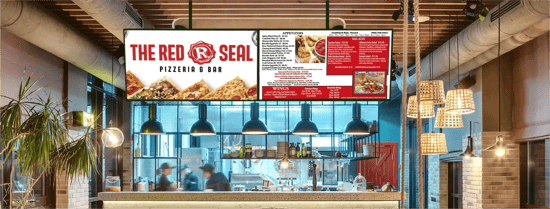
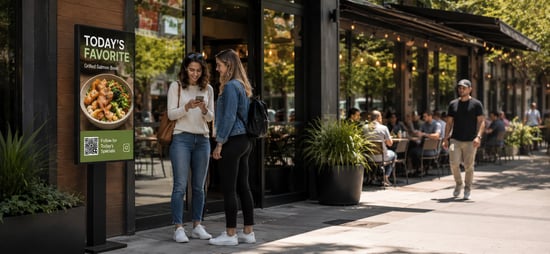
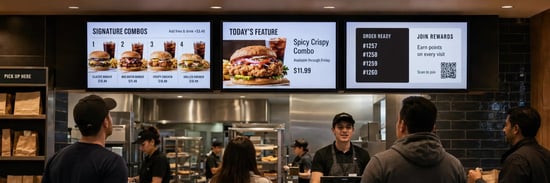
The person walking past your restaurant right now has already decided to eat out.
They have not decided where.
That is a five-second window. Street level. Moving. Whatever they see in that moment, or do not see, determines whether you get the cover or the restaurant across the road does.
Restaurant digital signage was built for that window. The moment before the door opens, when the decision is still up for grabs.
Here are 8 strategies that put restaurant foot traffic under your control, shift after shift, without adding to your advertising budget.
1. Make Your Window Do the Selling
Most restaurant windows are a printed menu, a price list, or nothing at all. None of these convert a moving person into a seated customer.
A screen showing today's featured dish, priced and named, with a relevant daypart offer, makes someone stop. Not because it is a screen. Because it is relevant to the exact second they are walking past at noon, looking for somewhere to eat.
Digital signage for restaurants at the entrance position is your highest-conversion real estate. It reaches people who have not committed to any destination. That is a more valuable conversion moment than anything happening inside your four walls.
2. Schedule Content by Daypart, Not by Week
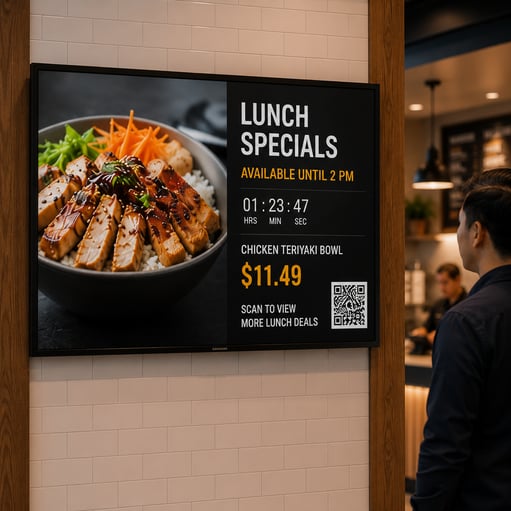 The offer that drives restaurant foot traffic at 11 am is not the same offer that moves it at 6 pm.
A breakfast crowd wants speed and simplicity. A lunch crowd wants a reason to stop. A dinner crowd wants to know what is worth sitting down for. One static message misses at least two of those three every single day.
Restaurant digital signage software handles this automatically. Set a breakfast window, a lunch push, a happy hour slot, and a dinner special. The right content appears at the right time without supervision. This is one of the fastest-growing restaurant digital signage trends among both independent operators and QSR chains because the results show up in covers within the first shift.
One platform. Every restaurant. Every daypart. Every shift.
Explore the Restaurant Platform →3. Put Social Proof Where Foot Traffic Passes 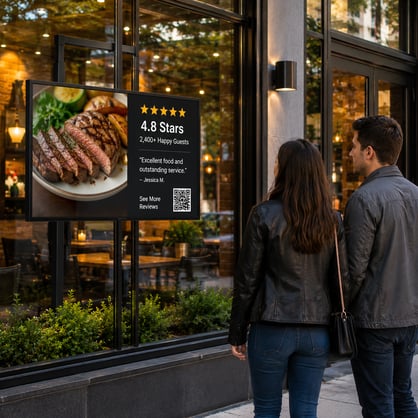
Most restaurants hide their best asset behind a screen. A 4.7-star average across 1,200 reviews is sitting on a Google listing a street-level customer will never open while walking past.
A digital signage display for restaurant entrances, surfaces that are positioned at eye level, outside, where the decision happens. A rotating customer quote, a visible star rating, a recent press mention, positioned where foot traffic passes, converts at a rate a website page never will.
People do not read menus from the pavement. They read signals. A strong review count, visible in the moment, is the most credible signal you have.
4. Give Every Promotion a Visible Deadline
A promotion with no endpoint reads as a permanent price. Customers mentally reclassify it as the standard offer and stop responding to it entirely.
A countdown visible on your display - "Today Only" or "Until 3 pm" - changes the decision for someone walking past. This is not manufactured pressure. It is making a real deadline visible at the right moment.
Restaurant foot traffic driven by urgency costs nothing beyond what you were already running as a promotion. A printed sign cannot update in real time. A managed screen does it automatically, every shift.
Related Reading
The complete guide to digital menu boards for QSRs and fast casual restaurants.
5. Use Outdoor Displays to Capture the Walk-By Before a Competitor Does
The instinct is to put screens where seated customers will see them. That is the wrong priority for restaurant foot traffic.
Digital signage for restaurants positioned at street-facing entry points, rather than inside the dining room, reaches people who have not yet chosen a destination. That is a fundamentally different and more valuable conversion moment.
The operators building restaurant foot traffic through exterior display positions are not running expensive ad campaigns. They are intercepting people who were already going to eat somewhere and giving them a reason to make it here rather than somewhere else.
6. Show Wait Times at the Door
Uncertainty kills foot traffic more reliably than a long wait does.
Someone pausing outside is not thinking, "I do not want to wait twelve minutes." They are thinking, "I do not know how long I will wait, and I do not want to find out the hard way." A screen showing current wait time or table availability removes that barrier before it stops them at the door.
This applies equally to quick-service restaurant digital signage and full-service operations. The principle is the same: visible information converts hesitation into a decision. No information sends the customer to wherever looks more predictable.
Related Reading
The display technology is changing how restaurants capture walk-in and pickup orders.
7. Drive-Thru Entry Is Your Highest-Traffic Moment 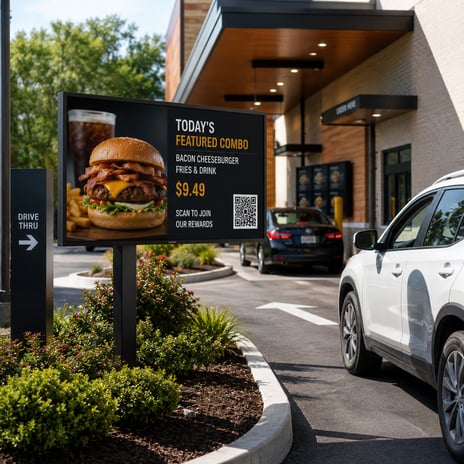
For QSR operators, the second a car slows at the drive-thru entry is the equivalent of the walk-by moment for a sit-down restaurant. The decision to pull in or keep driving happens in seconds.
A digital signage menu board for restaurant drive-thru entry changes what that decision is based on. Instead of a full static board requiring the driver to read everything, a managed screen shows the featured item, the current deal, or the fastest option at that hour.
Digital signage software for restaurants running centrally means the same breakfast-to-lunch content switch on your window display runs simultaneously at the drive-thru entry. One platform. Consistent execution. No manual updates at the site level.
Up Next
Foot traffic in. Now, here is how to make every cover count.
8. Measure What Drives Covers and Improve It Every Shift
Static displays give you nothing to work with. A printed poster runs for three weeks, and you have no way of knowing whether it influenced a single decision.
Digital signage solutions for restaurants give you content performance metrics. Which screens drove engagement during which daypart? Which promotions ran during a spike in covers? Which locations outperformed others and why?
Restaurant foot traffic is not a fixed number. It is a variable you can move. The operators treating restaurant digital signage as a measurement tool, not just a display tool, improve their foot traffic figures every month because they know what worked last week and they build on it.
What This Changes Operationally
Your window stops being a static fixture and starts converting passersby. Your drive-thru entry captures decisions that currently go to competitors. Your best promotions have visible deadlines. Your review count is at eye level, outside, where it actually influences a decision.
Restaurant digital signage applied to restaurant foot traffic does not require increasing your advertising budget. It works on existing traffic, people already moving past your location, and converts more of them, shift after shift, across every site.
If you want to see what deploying this looks like for your operation, reach out to our team.
Make it Visible.
Build a restaurant that fills itself, shift after shift.

Rated Best Customer Support
Software Advice
Frequently Asked Questions
What drives foot traffic to a restaurant?
Restaurant foot traffic is driven by visibility, relevance, and timing at street level. Customers walking or driving past make a split-second decision based on what they see in that moment. A visible special, a displayed wait time, a strong review count, or a time-bound offer all influence that decision before someone reaches for their phone to search. Restaurant digital signage addresses each of these in the window where the choice is actually being made.
How does restaurant digital signage increase foot traffic?
Restaurant digital signage increases foot traffic by placing a relevant, timely message in front of a passing customer at the exact moment they are choosing where to eat. Daypart scheduling, real-time promotions, social proof displays, and visible wait times all work on a customer who has not yet committed to a destination. That pre-entry moment is the most valuable conversion opportunity a restaurant has.
What is the best digital signage for restaurants focused on foot traffic?
The most effective digital signage for restaurants focused on foot traffic is positioned at entry points and street-facing windows rather than inside the dining room. Content should be a single, relevant message: the current featured offer, the wait time, or the strongest social proof available. A screen showing the lunch special to someone deciding where to eat at 12:15 pm is the foundation of a working restaurant foot traffic strategy.
Can digital signage software for restaurants manage content across multiple locations?
Yes. Restaurant digital signage software runs content centrally and pushes it to every screen at every location the moment it is approved. A chain running a new promotion does not need each site to update independently. The promotion goes live simultaneously across every display, with location-level targeting available where menus or pricing differ.
How quickly does restaurant digital signage affect foot traffic?
Most operators see measurable impact within the first month of consistent content management. Operators who use daypart scheduling from day one and track content against cover counts typically see the clearest early results.

Brent Nacu
CRO at L Squared Digital
Brent Nacu is the Chief Revenue Officer at L Squared Digital, with 20+ years in digital signage. He helps organizations build display strategies that improve engagement, streamline operations, and drive real results.
LinkedIn