Here's a number worth sitting with before we get into the strategies. According to research by Bain & Company, published in Harvard Business Review, a 5% increase in customer retention can increase profits by anywhere from 25% to 95%. Not a 5% jump in new traffic. A 5% improvement in keeping the customers you already have.
Most restaurant operators we talk to spend the majority of their energy on getting people through the door the first time. That makes sense. But the operators building genuinely profitable locations, not just busy ones, have figured out that the return visit is where the real economics live.
That's what restaurant customer experience is actually about. Not whether the food is good (it has to be, but that's baseline). The full sequence from the moment a guest approaches the counter to the moment they walk out. In hospitality, it gets called the restaurant guest experience. In QSR, it's the same thing with faster stakes. The question of how to improve customer experience in a restaurant isn't complicated. But it does require being deliberate about eight specific things that most operations leave entirely to chance.
How to Improve Customer Experience in a Restaurant: Satisfied vs. Regular
Satisfaction and loyalty are not the same metric. Worth saying clearly, because a lot of restaurant operators treat them as if they are.
A satisfied guest leaves thinking "that was fine." A regular leaves thinking "I'm going back to that specific place." The gap between those two outcomes isn't usually the food. In QSR, the difference between your product and the location down the road is narrower than most operators would like to admit. What creates a regular is predictability, reliability, and a reason to return. None of those require a renovation budget. All of them can be built deliberately.
Here are the eight places to build them.
1. Remove Friction at the Ordering Moment
Think about the last time you watched a first-time customer stand at a counter for 45 seconds longer than they needed to, squinting at a board that was either cluttered, outdated, or trying to show too much at once. They made a smaller decision than they would have with a clearer board. They left slightly less satisfied with it. And they probably didn't come back.
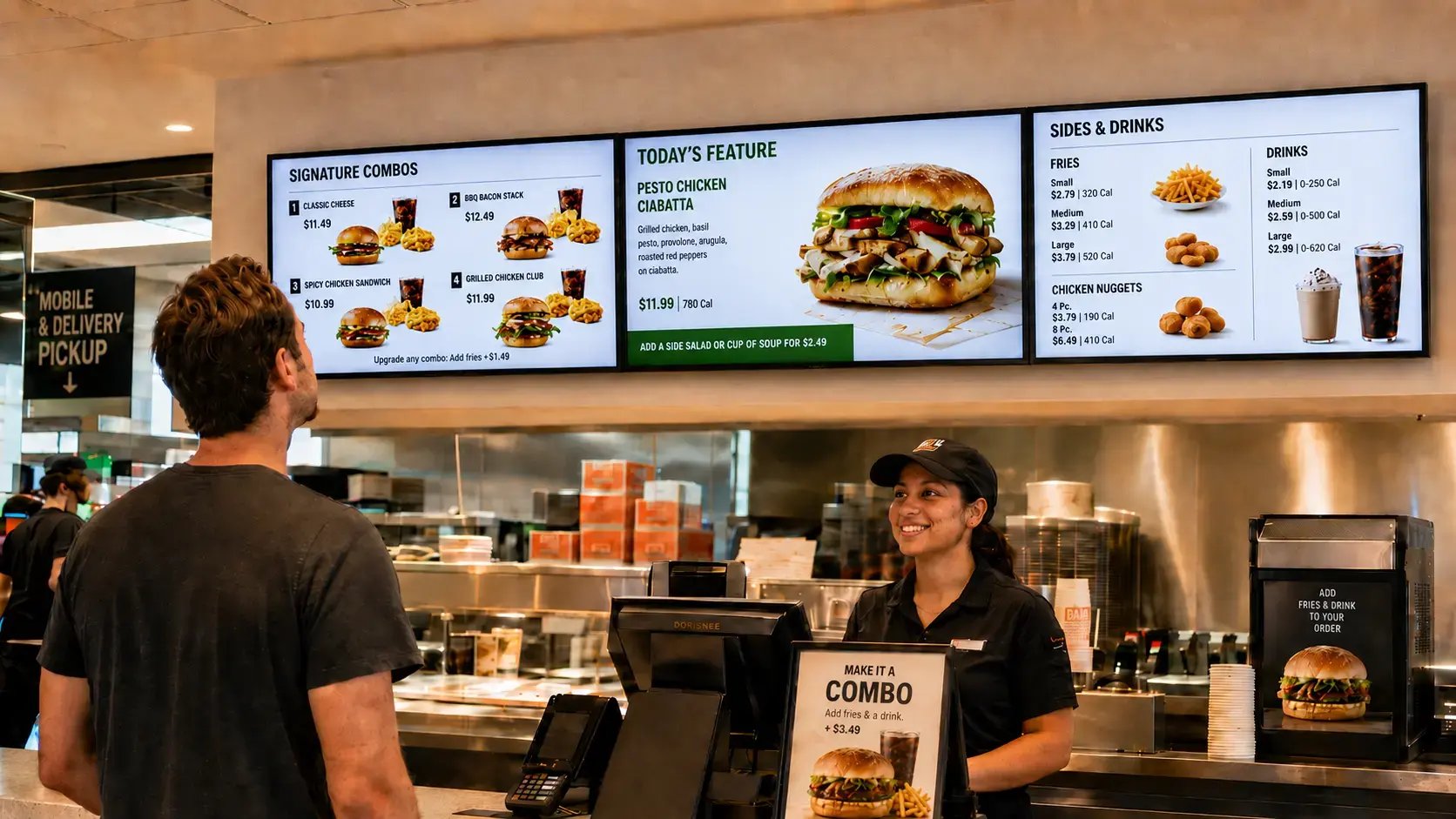
The ordering moment is the first real test of your operation for any new guest. A well-structured restaurant customer experience display does three things at once: it reduces decision time, directs attention to high-margin and featured items, and makes a first-time visitor feel confident rather than confused. Ordering confidence is the first building block of a return visit. Don't underestimate how much friction a cluttered or stale board creates at that specific moment.
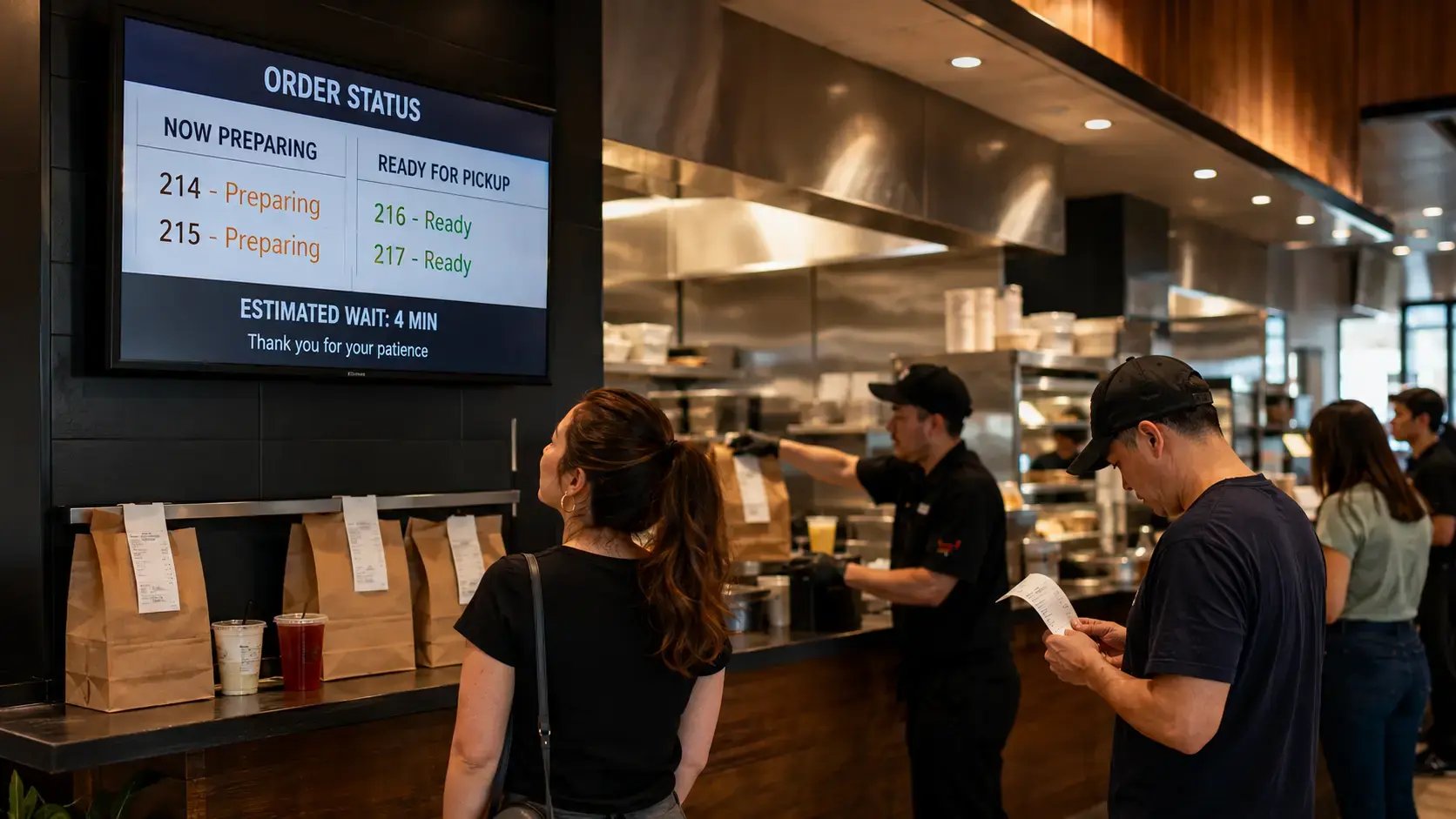
2. Communicate the Wait. Don't Make Guests Guess.
Here's something we see constantly: operators putting serious effort into reducing wait time while doing almost nothing to communicate wait times. Those are two different problems with two different solutions, and they don't have the same cost.
Research consistently shows that an unknown wait feels longer than a communicated wait, even when the actual duration is identical. A 3-minute wait you didn't announce feels like 6. A 3-minute wait with a clear expectation feels like 2. That's not theory. It shows up in satisfaction scores across QSR and fast-casual with remarkable consistency. If you're specifically looking at how to improve customer experience in fast food, this is one of the highest-leverage, lowest-cost changes you can make. Simple display communication solves it. It costs a fraction of the operational investment required to actually reduce your service time, and it moves the needle on guest satisfaction faster than most operators expect.
3. Get the Order Right. Every Time, Not Most Times.
Know this sounds obvious. It isn't treated that way nearly as often as it should be.
Order accuracy is the single most common driver of negative reviews and non-return decisions in QSR. Not wait time. Not price. Not staff attitude. The wrong item in the bag. In survey after survey across fast food and fast-casual categories, incorrect or incomplete orders come out as the top reason guests say they won't return to a specific location. Not the brand. That specific location.
Investment in accuracy, whether that means order confirmation screens, clearer back-of-house display systems, or tighter handoff protocols, has a direct line to your return rate. Get this right before investing in anything else on this list.
4. Acknowledge the Guest, Not Just the Order
There's a version of QSR service that processes customers efficiently without ever treating them like people. You know exactly what it feels like to be on the receiving end of it. Fast, transactional, forgettable. No particular reason to choose that location over any other one with the same menu.
The fix isn't a personality overhaul. Eye contact. A greeting that isn't on autopilot. Using the name when the order is called. These are protocol decisions, which means they can be trained and measured, not left to whoever happens to be on the counter that shift. The operations that make guest acknowledgment a standard expectation rather than a personality variable consistently see it reflected in their review scores. Set the standard. Train to it. Measure it.
5. Tell Guests Why They Should Come Back While They're Still in Front of You
This is the most consistently missed opportunity we see across restaurant operations, and it frustrates us every time.
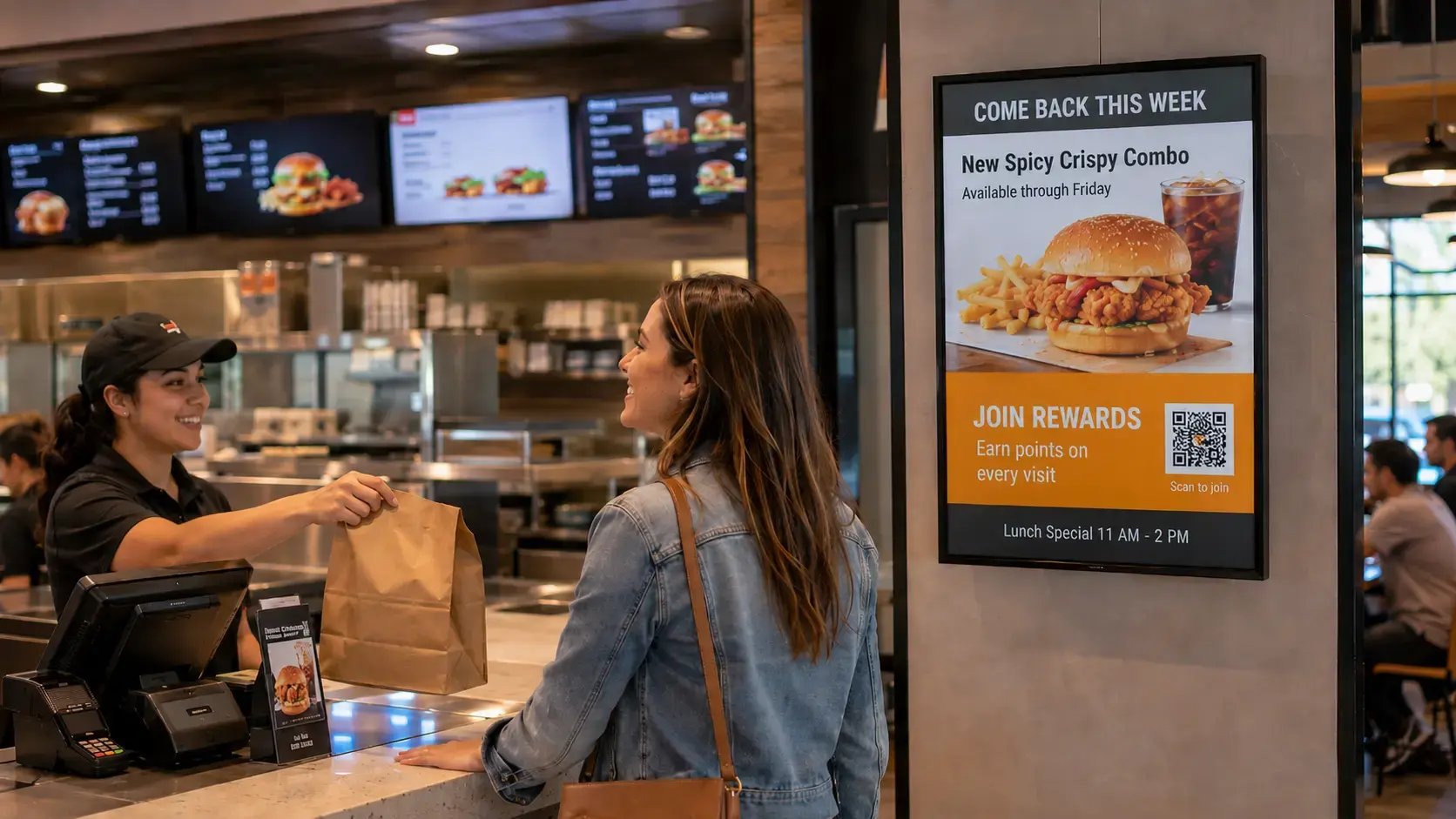
Most promotional budgets are aimed at people who aren't there yet. External ads, social posts, delivery platform spend. Almost nothing is built to reach the guest who is already inside, already decided to be there, already in a buying mindset. Your counter is the highest-intent marketing channel you have access to. The LTO launching next week, the loyalty programme they've never been told about, the combo that saves them money on the next visit. All of these need to be visible at the ordering moment, not buried in an app they haven't downloaded.
Smart digital menu board ideas for QSR show this consistently: in-restaurant promotion at the point of decision outperforms the same offer pushed externally. The audience is already standing there. Use the moment.
Want the playbook for in-restaurant promotion that actually drives return visits?
6. Deliver the Same Experience on a Tuesday at 2 pm as on a Friday at Noon
Regulars visit at different times. That's literally what makes them regulars. And what ends the relationship for a lot of them isn't a bad experience. It's an inconsistent one.
The location that was excellent at Saturday lunch is a noticeably different restaurant on Wednesday evening: lighter staffing, a board that hasn't been touched since the morning, an LTO that sold out three days ago still showing on screen. The guest who came back specifically to replicate their first visit can't find the same operation they decided to return to. That's an operations and communications problem, not a service personality problem.
Centrally managed display systems that update automatically by time of day and campaign schedule, without anyone on the floor needing to touch anything, are how multi-unit QSR brands hold the experience their regulars expect across every daypart and every shift. The guest doesn't know or care about your shift change at 3 pm. They just know whether it felt the same.
7. When Something Goes Wrong, Fix It Fast and Make It Visible
Service recovery is consistently underestimated as a loyalty driver. Research across hospitality and food service shows that a well-handled problem creates more loyalty than a visit where nothing went wrong at all. Think about that for a second.
A guest who watches your team take clear ownership of a mistake and fix it quickly walks away with more confidence in your operation than one who never had to test you. The mechanism is trust. And trust, in QSR, is what turns a satisfied one-time visitor into someone who specifically requests your location when they're in the car with their family at 6 pm on a Friday.
What this requires is a defined recovery protocol. What is every team member empowered to do when an order is wrong or a wait runs long? If that answer isn't consistent and clear across your locations, you're leaving the guest experience to individual judgment under pressure. That's a management decision showing up as a staffing problem.
See how Hilton Suites made guest experience consistent across every property with Digital Signage
Read the Case Study →8. Give Returning Guests Something New to Notice
A restaurant that looks and feels identical on every single visit gives the returning guest nothing to reward the loyalty, nothing to mention to someone else, and no signal that the operation is paying attention to the people who keep coming back.
Regular guests notice when nothing changes. They don't always say it. They eventually just stop coming as often.
This doesn't require a new menu or a redesign. A seasonal feature item. A limited-time add-on with a short window. A staff recognition callout on the counter screen. Something that tells the repeat visitor: things move here, and you caught something you'd have missed if you hadn't been back. Electronic menu boards that update by daypart, day of week, or campaign window make this simple to execute consistently. The creative decisions are yours. The deployment runs automatically.
Measuring Restaurant Customer Satisfaction After You've Made Changes
If you make changes to any of these areas, you need a way to know whether they're working. Here's what actually measures restaurant customer satisfaction in a QSR context, as opposed to what just feels good to track:
-
Return visit rate. The share of guests who visit more than once within a defined window. Your POS data surfaces this if you have any loyalty or order identification running. This is the number that tells you whether the experience is actually landing.
-
Review score trajectory. Not the absolute score. The direction. A meaningful improvement in guest experience shows up in review scores within four to six weeks of consistent operational change. If it isn't moving, something in the execution isn't holding.
-
Post-visit survey results. If you're running these, the questions that matter most are order accuracy and intent to return. Those two predict actual behaviour more reliably than overall satisfaction ratings, which tend to capture how people feel in the moment rather than what they'll actually do next.
-
Attach rate on promoted items. If you're running LTO or upsell promotions through in-restaurant displays, your POS will tell you whether attach rate changes when those promotions are actively running versus when they aren't. That delta is your display ROI signal, and it's more honest than most measurement frameworks operators use.
These aren't vanity metrics. They're the feedback loop that tells you whether the restaurant guest experience you're building is converting the people you want to keep.
Customer Touchpoint Audit Checklist
Before investing in any of the strategies above, run this across your locations. The rows that score lowest are where to start.
|
Touchpoint |
What to evaluate |
Status |
|
Menu display |
Is pricing current and legible at counter viewing distance? |
Pass / Needs work |
|
Menu display |
Are high-margin and featured items visually prominent? |
Pass / Needs work |
|
Wait communication |
Do guests receive any signal of expected wait time? |
Pass / Needs work |
|
Order collection |
Is the pick-up or order-ready process clear to a first-time visitor? |
Pass / Needs work |
|
Order accuracy |
Is accuracy tracked? What is the current error rate? |
Pass / Needs work |
|
Staff greeting |
Is guest acknowledgment a defined protocol or personality-dependent? |
Pass / Needs work |
|
LTO / promotion visibility |
Are current promotions visible at the ordering moment? |
Pass / Needs work |
|
Loyalty programme |
Is the programme mentioned consistently at the point of transaction? |
Pass / Needs work |
|
Content freshness |
When was the in-restaurant display content last updated? |
Pass / Needs work |
|
Shift consistency |
Does the Tuesday 2 pm experience match the Friday noon experience? |
Pass / Needs work |
Any row that scores "Needs work" is a return visit being left on the table.
Scored a few "Needs work" rows?
Tell us which ones and our team will point you to the right starting point for your operation.
Frequently Asked Questions
How to improve customer experience in restaurant?
Start with order accuracy and ordering clarity. Those two have the highest direct impact on return rate and are the most correctable. From there, communication of wait time, consistent shift-to-shift execution, and visible in-visit promotion (LTO, loyalty programme mention at the counter) are the levers that move a satisfied first-time guest toward a regular. The most common mistake is spending budget on the pre-visit experience while leaving what happens inside the four walls to chance.
What affects restaurant customer experience?
The most measurable factors are order accuracy, wait time communication, staff acknowledgment quality, and consistency across dayparts and shift changes. Environmental factors like cleanliness and display clarity operate as hygiene factors: below a threshold they actively damage satisfaction, but above it they don't drive loyalty on their own. The operational factors are where the loyalty outcomes actually live.
How do you improve customer experience in fast food?
In fast food specifically, speed and accuracy are baseline expectations. They're table stakes, not differentiators. What moves a first-time visitor to a regular in a fast food context is consistent order accuracy, visible in-restaurant promotion that creates a specific reason to return, and a counter interaction that feels like an acknowledgment rather than an automated transaction. All three are trainable and measurable. None require structural changes to the operation.
How do you measure restaurant customer satisfaction?
Track return visit rate through POS or loyalty data, review score trajectory (direction matters more than the absolute number), and attach rate on actively promoted items. If you run post-visit surveys, prioritise order accuracy and intent to return. Those two predict actual behaviour far better than overall satisfaction scores. Also measure the gap between your quieter shift scores and your peak shift scores. Consistency across dayparts is one of the most telling indicators of whether the experience you're building is actually systemised or just personality-dependent.
What is the most important factor in restaurant guest experience?
Order accuracy, consistently. It's the one factor that, when it fails, is more likely to prevent a return visit than any other single variable, including wait time and staff friendliness. Guests expect reasonable speed and basic acknowledgment. What they remember negatively, and what drives the decision not to come back, is getting the wrong order. Fix accuracy before investing in anything else.
L Squared: One Stop Solution for all your Restaurant & QSR Digital Signage Requirements.
If you want to look at how in-restaurant display systems support the restaurant guest experience strategies above, from ordering clarity and LTO visibility to shift-consistent content that runs without anyone on the floor needing to manage it, talk to our team.

-1.png?width=167&height=25&name=LS%20Logo%20Colour%20(Horizontal)-1.png)

Brent Nacu
CRO at L Squared Digital
Brent Nacu is the Chief Revenue Officer at L Squared Digital, with 20+ years in digital signage. He helps organizations build display strategies that improve engagement, streamline operations, and drive real results.
LinkedIn