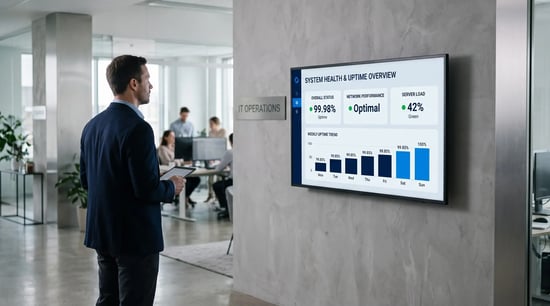
The screen on the wall has not changed much to look at. What it is expected to do has changed a great deal. Heading into 2027, enterprise digital signage is quietly becoming a piece of communication infrastructure, judged less on how it looks and more on how it integrates, how it is secured, and who it reaches. For a team planning a deployment or a renewal, the useful question is not which trend is loudest. It is the shifts that actually change the platform decision. Here are the five that do.
Quick Takeaway
Security is moving from a differentiator to a baseline requirement, audits, not claims.
Screens are becoming data-driven and integrated, not fixed playlists someone updates by hand.
The deskless workforce is becoming a primary audience, not only customers.
AI is arriving, and the value is in useful assistance, not the hype.
Measurement is becoming non-negotiable: buyers want proof of value, not promises.
The five shifts reshaping enterprise digital signage
Security
From differentiator to baseline requirement.
Data-driven
Live data replaces fixed playlists.
Deskless reach
Screens reach the whole workforce.
AI, minus the hype
Useful assistance, judged on evidence.
Measurement
Proof of value becomes non-negotiable.
The shift, at a glance
Security moves from differentiator to requirement
For years, strong security was something a digital signage vendor could claim as an advantage. Heading into 2027, it is becoming the price of admission. As deployments grow and connect to internal systems, IT and procurement teams are treating a digital signage platform the way they treat any vendor touching the network, and that means asking for evidence. It means the actual artifacts, a SOC 2 Type II report and an ISO 27001 certification, rather than marketing language about being secure. The shift is subtle but decisive. A platform that cannot produce independent audits is increasingly being screened out before the feature conversation even begins.
- The shift: independent audits, SOC 2 Type II, and ISO 27001, become the price of admission.
- For buyers: a platform that cannot produce audits is screened out before features are even discussed.
Digital signage becomes data-driven, not playlist-driven
The biggest functional change is what appears on the screen and where it comes from. The old model was a playlist, a fixed loop of content that someone updated by hand. The 2027 model is live data. Screens pull from the systems an organization already runs, business intelligence dashboards, operational metrics, scheduling, and communications platforms, so what shows is current without anyone touching it. A production line displays real output against the target. A corporate floor shows a live KPI board. A store reflects inventory as it changes. This is where integration depth becomes the real capability question. A platform that connects cleanly to the tools an organization already uses, such as business intelligence dashboards and communication platforms, turns screens into a live window on the business. One that cannot leave a team behind in the manual-update era.
- The shift: screens pull live data from existing systems instead of running fixed playlists.
- For buyers: integration depth becomes the real capability question, not the content editor.
See how L Squared connects digital signage to the systems you already run.
Talk to L SquaredThe deskless workforce becomes a primary audience
Most enterprise communication tools assume a desk, an inbox, and a login. A large share of the workforce has none of those. The people on a plant floor, in a warehouse, behind a counter, or moving between sites are among the hardest to reach, and often the most important to inform, and heading into 2027, more organizations are treating them as a primary digital signage audience rather than an afterthought. On-screen communication reaches deskless staff where email and intranets never will: shift information, safety notices, recognition, and company updates, delivered to the floor at the same moment they reach everyone else. The trend is a new reason for the screens, internal communication that finally includes the people without a desk.
- The shift: the deskless workforce becomes a primary internal-communication audience.
- For buyers: on-screen communication reaches staff that email and intranets never do.
AI arrives in digital signage, minus the hype
AI is the loudest trend and the one most worth reading carefully. According to MarketsandMarkets, AI is moving digital signage from static, schedule-based playback toward content that adapts to real-time inputs. In practice, heading into 2027, the useful applications are concrete rather than magical: assisting with content creation and layout, predicting the best time to show something, and flagging a screen or player that is about to fail before it goes dark. The honest read is that AI is a genuine efficiency and reliability gain, and it is oversold at the edges. The buyers who benefit are the ones asking what problem it solves on their screens, rather than whether the box says AI. Treat it as a capability to evaluate on evidence, the same as any other.
- The shift: AI assists content, scheduling, and monitoring, useful, not magic.
- For buyers: evaluate it on the problem it solves, not on the AI label.
Judge a platform on evidence. See how L Squared measures up on security, integration, and support.
Talk to L SquaredMeasurement becomes non-negotiable
As digital signage budgets move from facilities to marketing and operations, they come with harder questions about return. Buyers heading into 2027 increasingly expect a platform to help them prove value, not just promise it, and the market is not there yet. In adjacent in-store media, only 12% of retail media networks can activate and measure a campaign across on-site, off-site, and in-store together, according to Koddi and Forrester in November 2025. That gap is an opportunity for the buyer. A platform that helps a team baseline, measure, and show a result is worth materially more than one that cannot, and it is becoming a real differentiator.
- The shift: buyers expect platforms to help prove value, and few can today.
- For buyers: the ability to baseline, measure, and show a result is becoming a real differentiator.
What the 2027 shifts mean for your platform choice
Read together, these shifts point in one direction. Enterprise digital signage in 2027 is judged as infrastructure, on how securely and deeply it integrates, how widely it reaches, and how well it proves its worth, rather than on a feature list. That raises the stakes on the platform decision, because these are architectural capabilities that cannot be bolted on later. For the criteria that follow from this, the guide to selecting a digital signage vendor is a useful companion, and it pairs with the way the vendor landscape itself is changing as the category consolidates.
Frequently asked questions
What are the biggest digital signage trends for 2027?
Five shifts stand out: security moving from a differentiator to a baseline requirement, screens becoming data-driven and integrated rather than fixed playlists, the deskless workforce becoming a primary internal-communication audience, AI arriving as useful assistance rather than hype, and measurement becoming a non-negotiable expectation. Together, they move digital signage from a display to a piece of communication infrastructure.
Why is security a leading digital signage trend for 2027?
Because digital signage now connects to internal systems, IT and procurement teams evaluate it like any networked vendor. Heading into 2027, they increasingly require independent evidence, a SOC 2 Type II report, and ISO 27001 certification, rather than marketing claims. Platforms that cannot produce audits are screened out earlier in the process.
What does data-driven digital signage mean?
It means screens display live information pulled from the systems an organization already uses, such as business intelligence dashboards, operational metrics, and communication platforms, so content stays current automatically. It replaces the old model of a fixed playlist that someone updates by hand, and it depends on how well a platform integrates.
How is AI actually used in digital signage?
The concrete applications are content assistance, predictive scheduling, and automated monitoring that flags failing hardware early. AI is a real efficiency and reliability gain, and it is oversold in places. The useful test is what problem it solves on your screens rather than whether a platform simply markets itself as AI-powered.
What should enterprises prioritize in a 2027 digital signage platform?
Prioritize what cannot be added later: audited security, deep integration with existing systems, the reach to include deskless staff, and the ability to measure and prove value. These architectural capabilities, rather than a long feature list, determine whether a platform still serves the organization as requirements grow.
The Bottom Line: Digital Signage as Infrastructure
The through-line for 2027 is that digital signage is being asked to behave like infrastructure. Secure by evidence, integrated by default, reaching everyone, including the people without a desk, and accountable for its results. The organizations that get value from it will be the ones that choose a platform on those terms, not on which product has the most features on a slide.
At L Squared, that is the standard the platform is built to: an independent, enterprise platform that is SOC 2 Type II and ISO 27001:2022 certified, integrates with the systems you already run, and is backed by 24/7/365 human support on every tier. As digital signage becomes infrastructure, L Squared's answer is people and platform, the technology to do the job, and the team to keep it dependable at scale.
Built for how digital signage works in 2027
Secure, integrated, and supported by people. See how L Squared approaches enterprise digital signage.
Talk to L Squared
.jpg?width=550&height=395&name=blog%20images%204-28%20(1).jpg)