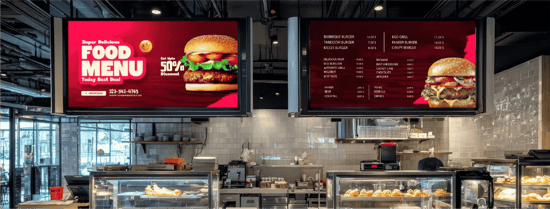
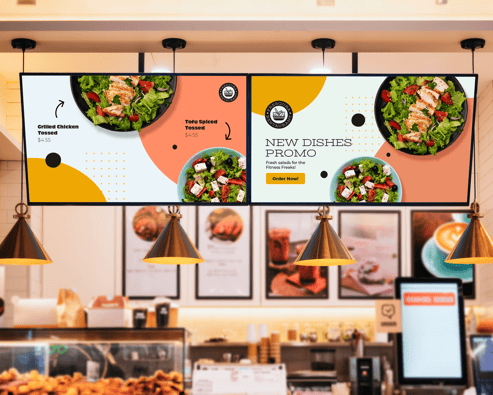
Say "restaurant digital signage" and most people picture a digital menu board. That is where it starts, not where it ends. The menu board is table stakes now, expected, useful, and only a fraction of what digital signage does for a quick-service restaurant. The value that separates a good QSR signage program from a wall of screens is everywhere else: the drive-thru, the pickup counter, the promotion that has to launch in every location at once, and the ability to run all of it consistently across hundreds of stores. This is what QSRs use digital signage for beyond the menu board.
Quick Takeaway
The digital menu board is table stakes. The bigger value is in the drive-thru, pickup, promotions, and back-of-house.
Dayparting lets menus and offers change on their own, breakfast to lunch to dinner, without anyone touching a screen.
The hard part is consistency: a new promotion has to be live and correct in every location, not most of them.
At chain scale, that takes a platform to run it centrally and the people to keep it dependable.
Beyond the menu board: what QSRs use digital signage for
The menu board earns its keep, and there is a full guide to digital menu board costs if that is where you are. Everything below is the part people forget to plan for.
- The drive-thru. For most QSRs, the drive-thru is the majority of business, and it is where digital signage does the most work: dynamic drive-thru menus, order confirmation displays that show items as they are rung up, and offers timed to the moment.
- Order and pickup status. As mobile order, delivery, and pickup grow, on-screen order-ready boards keep the counter moving and reduce the crowd and confusion around it.
- Promotions and limited-time offers. Launch a new LTO, feature a combo, or push a daypart deal, and have it appear across every location on schedule, without reprinting or reshipping anything.
- Dayparting. Menus and content that change by time of day on their own, the breakfast menu becomes the lunch menu, becomes the dinner menu, correctly, everywhere, without a manager flipping a switch.
- Queue and counter communication. Reduce perceived wait and communicate at the point where attention is captive.
- Back-of-house. Kitchen and crew screens for targets, safety, and shift information, reaching the staff who never see an email.
Beyond the menu board
Drive-thru
Dynamic menus and order confirmation.
Order & pickup
Order-ready boards that keep the counter moving.
Promotions
LTOs live in every store on schedule.
Back-of-house
Crew screens for targets and safety.
The drive-thru is where it pays off
If a QSR gets one thing right with digital signage beyond the menu board, it should be the drive-thru, because that is where the volume is. Digital drive-thru menus let content change by daypart and update instantly for a new offer or a sold-out item. Order confirmation screens show guests their order as it is entered, which cuts errors and the remakes that follow. And because the content is scheduled and centralized, the right menu and the right promotion are showing at the right time without a crew member managing it. None of this is exotic. It is the difference between a drive-thru that runs on current, correct information and one running whatever was loaded last month.
The real challenge: consistency across every location
For a QSR chain, digital signage is less a creative exercise than a distribution one. A new LTO or an updated price has to reach every relevant screen in every store, on schedule, and actually be displayed when a customer looks up. At the scale of hundreds of locations, the failure modes multiply: a store still showing last week's promotion, a location that never received the update, a drive-thru screen that went dark during the lunch rush. A promotion running in most of your stores is not a partial win; it is an inconsistent brand and a campaign you cannot measure. Consistency at scale is the whole game, and it is an operational capability rather than a design one.
See it for yourself
Run every store's screens from one place
See how L Squared runs QSR digital signage across a chain, dayparted, confirmed live in every location, and monitored.
Book a demoRunning QSR digital signage at scale
Running signage reliably across a chain comes down to a few platform capabilities. Centralized management means every screen in every store runs from one dashboard, with role-based access so head office and franchisees each control the right displays. Scheduling and dayparting let menus and promotions change by date and time automatically, so a campaign launches everywhere at once. Content confirmation, the step most platforms skip, shows which screens have actually downloaded and are displaying the right content, so you know an LTO is live in every store rather than just that you pressed send. And proactive monitoring flags a screen that has gone dark before a customer in the drive-thru does.
That is also why the platform and the people behind it matter as much as the content. A national signage program is a multi-year commitment, and the vendors worth choosing are the ones who keep it dependable. For L Squared, that shows up in a net retention rate of 107.7%, customers who stay and grow with us. For the broader criteria, our guides to selecting a digital signage vendor and securing signage across locations are useful companions.
Frequently Asked Questions
What is restaurant digital signage used for beyond menu boards?
Beyond digital menu boards, restaurants use digital signage for dynamic drive-thru menus and order confirmation, order-ready and pickup boards, promotions and limited-time offers pushed to every location, dayparting that changes content by time of day, queue and counter communication, and back-of-house crew screens for targets and safety.
How does digital signage help the drive-thru?
Digital drive-thru menus change by daypart and update instantly for a new offer or a sold-out item, and order confirmation screens show guests their order as it is entered, which reduces errors and remakes. Because content is scheduled and centralized, the right menu and promotion display at the right time without staff managing it.
What is dayparting in restaurant digital signage?
Dayparting is scheduling content to change automatically by time of day, so the breakfast menu becomes the lunch menu becomes the dinner menu on its own, correctly, in every location. It lets a chain run the right menu and offers at the right time without a manager switching screens.
How do QSR chains keep promotions consistent across all locations?
Through a centralized platform with scheduling, a promotion launches everywhere on time, and content confirmation, which shows which screens are actually displaying the right content. This is the difference between knowing a limited-time offer is live in every store and hoping it is.
Why is consistency the hardest part of restaurant digital signage?
Because a single update has to reach every relevant screen in every location, on schedule, and actually be displayed, and at the scale of hundreds of stores, small failures multiply. A promotion running in most stores, but not all, is an inconsistent brand and unreliable measurement. Centralized management, confirmation, and monitoring keep it consistent.
The Bottom Line: The Menu Board Is the Start, Not the Story
Restaurant digital signage is easy to reduce to the menu board, and that misses most of the value. The drive-thru, order and pickup, promotions, dayparting, and back-of-house are where a QSR program earns its return, and getting them right across a whole chain is an operational challenge, not a creative one. The screens are the easy part. The platform that keeps every one of them showing the right thing, and the people who keep it running, are what make it work.
That is the job L Squared is built for: QSR digital signage that dayparts on its own, confirms it is live in every store, and runs across every location from one place, backed by people who keep it dependable. People and platform, so the offer you launch is the offer every store actually shows.
One platform for every location
See how L Squared runs QSR digital signage across a chain, dayparted, confirmed, and monitored.
Book a demo
Brent Nacu
CRO at L Squared Digital
Brent Nacu is the Chief Revenue Officer at L Squared Digital, with 20+ years in digital signage. He helps organizations build display strategies that improve engagement, streamline operations, and drive real results.
LinkedIn