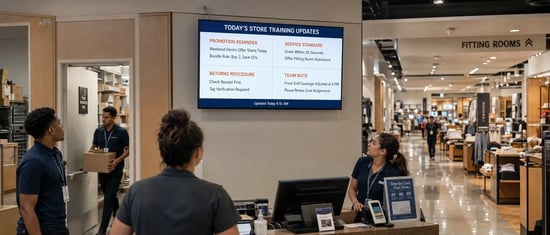
You can have the right products at the right price in the right location. A clean store. Well-trained staff. Strong foot traffic from a campaign that worked.
And still leave a significant amount of revenue on the floor every single shift.
The problem is rarely what you stock. It is what shoppers see, when they see it, and whether it is relevant to the exact moment they are standing in.
According to POPAI - the Global Association for Marketing at Retail - 76% of all purchase decisions are made in-store. Not during the ad that drove the visit. Not in the search that brought someone to your door. Inside the store, after they walked through it. At a shelf, at a counter, while they are waiting.
If 76% of the final purchase decision happens inside your four walls, then the campaign that drives foot traffic starts the journey. What your shopper sees after they walk in - and when they see it - determines whether that journey ends in a sale. Both matter. This guide focuses on the conversion side: what retail digital signage does once a shopper is inside.
That is exactly where retail digital signage does its most measurable work. Not as decoration. Not as a novelty. As the infrastructure that puts the right message in front of the right person at the right moment - shift after shift, without anyone having to update a poster or reprint a sign.
Here are 10 tactics that increase sales in retail using retail digital signage, and the logic behind why each one works.
Quick Takeaways
76% of purchase decisions happen inside the store - your screens are your last sales tool before the transaction.
Daypart scheduling lets you run the right promotion at 8 am, noon, and 6 pm automatically - no staff required.
A visible countdown timer makes real deadlines real - urgency without manufacturing false pressure.
Multi-location retailers lose revenue to inconsistency - centrally managed signage pushes the same promotion everywhere the moment you approve it.
Content performance data closes the loop - the right software tells you which screens, offers, and locations actually drove results.
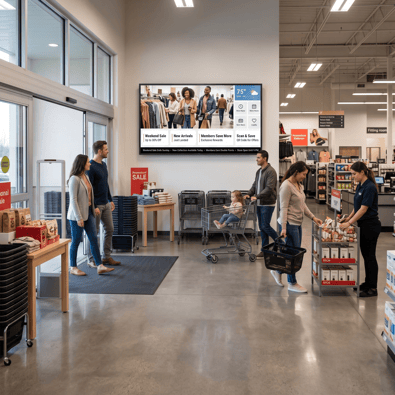 1. Put Your Best-Selling Products Where Eyes Land First
Most retail stores are laid out for inventory logic, not for how buyers actually move through a space.
The product most likely to convert is not always in the position that captures attention when a shopper walks in. A screen near the entrance changes that without changing the floor plan. Surface your highest-demand item, your most-purchased product that week, or the thing that converts fastest - before a shopper starts browsing on autopilot.
You are not changing the layout. You are directing attention to what matters most, at the moment it matters most.
2. Change What You Promote by Time of Day - Automatically
The offer that performs at 8 am rarely performs the same way at 6 pm. Morning shoppers are in a different mindset. Different timeline. Different needs.
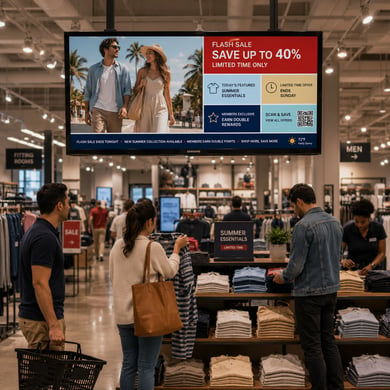
Manual promotion changes require someone on the floor to remember, print, and update. That rarely happens consistently across every shift, at every location. Retail digital signage handles it automatically. Set a morning promotion, a lunch offer, an end-of-day push - and the right content appears on the right screen at the right time, without supervision.
This is one of the most direct retail digital signage tactics for increasing sales in retail because it aligns your message with shopper intent as it changes throughout the day.
One platform. Every screen. Every shift. Every store.
Explore the Retail Platform →3. Give Every Limited-Time Offer a Visible Deadline
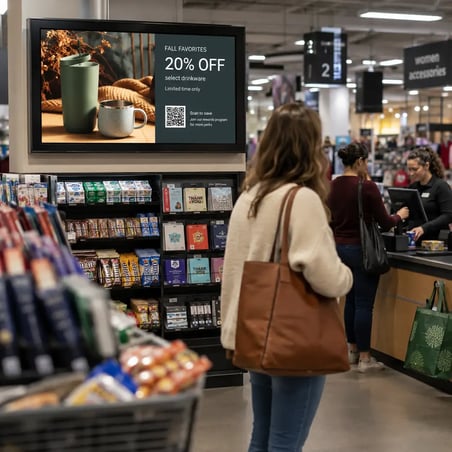
Urgency drives decisions. A promotion without a clear endpoint feels permanent - and permanent promotions feel like the regular price. Shoppers discount them.
A countdown displayed on retail store digital signage near the point of purchase changes that dynamic. When a shopper can see a deal ends at the close of business today, the calculation shifts. This is not about manufacturing false pressure. It is about making real deadlines visible. A static sign cannot do that. A managed screen can.
4. Make the Upsell Visible at the Moment of Decision
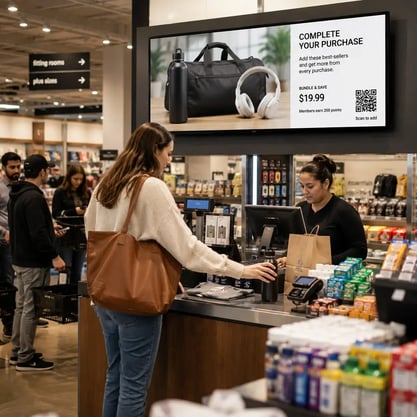
Most upsell opportunities are missed not because shoppers do not want the add-on. They miss them because no one mentioned it, or the offer was buried, or the promotion was not visible at the point of sale.
Digital signage for retail stores solves this structurally. A screen positioned at the counter, near self-checkout, or at high-traffic product zones can surface complementary products, bundle offers, or value-add upgrades exactly when a shopper is in buying mode. You are not asking staff to remember every upsell script on every transaction. The screen handles the prompt. The shopper makes the call.
5. Put High-Margin Products in Visual Priority Positions
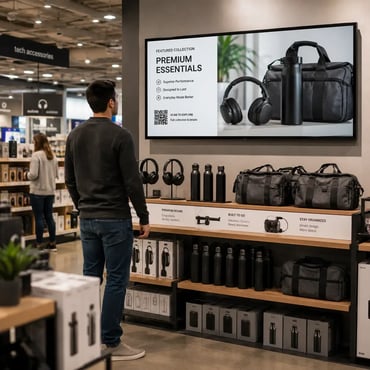
Retail digital signage strategy is not just about what you display. It is about where.
Not all products deserve equal screen time. Your highest-margin items should occupy your highest-attention display zones. A screen at eye level near a category can shift purchase behaviour without adjusting a single price or rearranging a single shelf. The benefits of digital signage in retail are most visible here - you are not changing the product. You are changing what gets noticed first.
See the numbers behind why retail digital signage works.
 6. Sign Up Loyalty Members at the Point of Sale
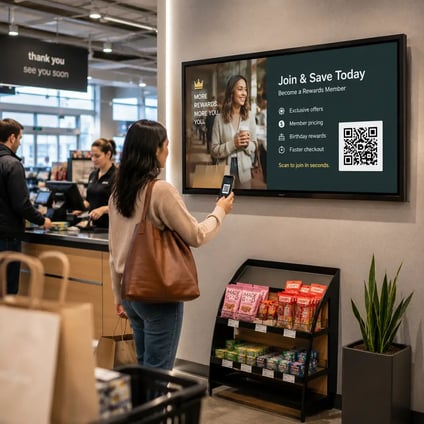
Most loyalty programmes underperform not because the offer is weak, but because the ask arrives through the wrong channel at the wrong time. A follow-up email three days after a visit does not convert. A screen at the counter while a shopper is completing their purchase does.
Retail digital signage at the checkout, showing the loyalty offer with a clear QR code or simple call to action, puts the question in front of a shopper who is already engaged. Their wallet is out. The value proposition is front and centre. That is the right moment - and it is the moment a static sign cannot reliably capture.
7. Run the Same Promotion Consistently Across Every Location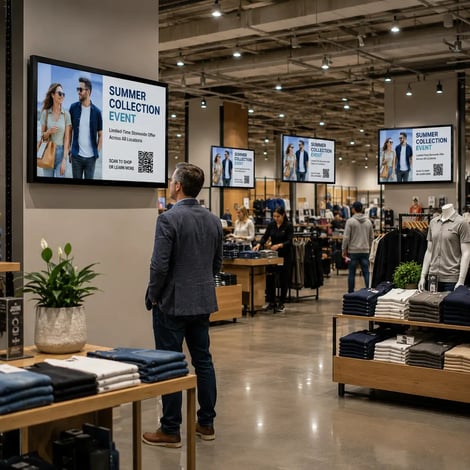
This is one of the most undervalued benefits of digital signage in retail for any operator running more than one store.
Inconsistency costs money. If your flagship is running a promotion that your second store has not heard about, you are leaving revenue behind and creating a disjointed brand experience. Centrally managed retail digital signage solutions push the same content to every screen at every location the moment you approve it. No email chain. No manager remembered to change the window display. No variation.
The UPS Store deployed retail digital signage across its franchise network for exactly this reason - consistent communication standards, across thousands of independently operated locations.
Case Study
Franchise scale. One standard. Here is how The UPS Store did it.
 8. Show Social Proof Where Purchase Decisions Happen
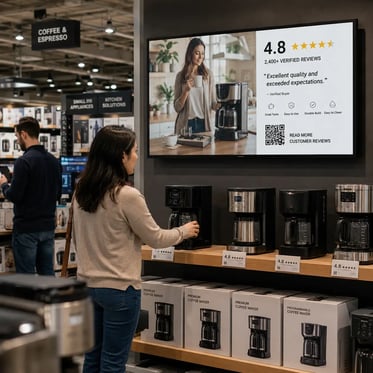
People trust other people. A product with a visible four-star average and 400 reviews is more persuasive than the same product with no social context - even when the shopper has never read a single one of those reviews.
Retail store digital signage near high-consideration products can surface curated ratings, review counts, or customer quotes at the moment a shopper is deciding whether to add something to their basket. This is proof at the point of decision. Not buried on a website page someone did not visit.
9. Reduce the Perception of Wait Time - and Use It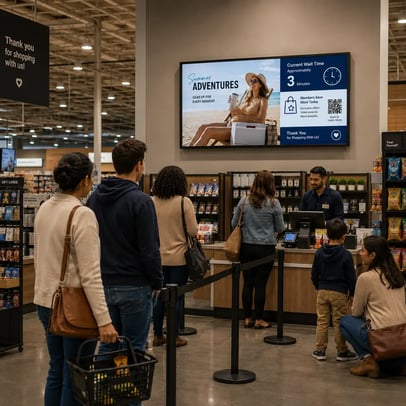
Shoppers who feel they are waiting too long buy less, return less, and recommend less. But wait time frustration is often not about the duration. It is about the absence of information during it.
A screen near a queue or a service counter that shows wait times, surfaces current offers, or highlights loyalty programme benefits changes the perceived experience. The wait feels shorter. A well-placed promotion during that dwell time generates revenue that would not exist without it. Retail digital signage implementation in waiting areas is one of the highest-ROI deployments available to most retailers.
10. Measure What Works and Improve It the Next Day
Static displays give you no data. You run a promotion for two weeks and have no idea whether it moved any product or changed any behaviour.
The right digital signage software for retail stores gives you content performance metrics. Which screens drove the most attention. Which promotions outperformed the control. Which locations converted at a higher rate. That data closes the loop and makes every subsequent iteration of your retail digital signage implementation smarter than the last.
This is the difference between retail digital signage as a decoration decision and retail digital signage as a retail digital signage strategy built around continuous improvement.
What Changes When You Deploy Retail Digital Signage
The shift is not just tactical. It is operational.
Staff spend less time on manual display updates. Promotions stay consistent across locations without a coordinator managing it. New product launches go live on every screen the moment they are approved. Your in-store experience starts reflecting your brand strategy rather than the last person who updated the window.
How to increase sales in retail using retail digital signage is not a single decision. It is a system. Each of these 10 tactics works independently. Together, they turn your retail floor into an active sales channel - not just a place to browse.
What Operators Who Have Done This Seen
Rogers Wireless used centrally managed retail digital signage to keep floor staff aligned on rapidly changing products and plans, and to keep customers informed during high-traffic periods. The UPS Store applied retail digital signage across their franchise network to deliver consistent retail digital signage strategy at every location, regardless of who was managing the store that day.
These are not technology projects. They are revenue decisions made by operators who recognized that what happens inside the store is the last mile of every marketing investment they had already made.
Related Reading
Your displays are selling. Is your floor team ready to close?
The In-Store Opportunity Most Retailers Are Still Missing
Most retail marketing is built to drive people through the door. Very little of it is built for what happens once they are in.
Retail digital signage closes that gap. It takes the revenue you are already spending to drive foot traffic and converts it more consistently. Every shift. Across every location. Without adding headcount or increasing your advertising budget.
If you want to see what increasing sales in retail looks like with retail digital signage deployed specifically for your stores, reach out to our team.
Make it Visible.
Build a retail floor that sells on every shift.

Rated Best Customer Support
Software Advice
Frequently Asked Questions
How does retail digital signage help increase sales in retail?
Retail digital signage increases sales by placing the right message at the right moment in the customer journey. Promotions, upsells, and product spotlights appear where purchase decisions are being made - at the counter, near high-traffic shelves, or in waiting zones - rather than in advertising channels the shopper has already moved past. This lifts average transaction value and drives impulse purchasing without requiring additional ad spend.
What is the most effective retail digital signage strategy for multi-location retailers?
The most effective retail digital signage strategy for multi-location operators is centralized content management with location-level targeting. Push the same core promotions across every store simultaneously while allowing individual screens to surface content relevant to their specific customer mix. The result is brand consistency and campaign reach at scale, without the manual overhead of managing each store separately.
What should I look for in digital signage software for retail stores?
The right digital signage software for retail stores should support daypart scheduling, allow centralized content management across multiple locations, integrate with your existing POS or inventory systems, and provide content performance analytics. Ease of publishing is as important as features - if your team needs IT support every time they want to update a promotion, the system will not be used consistently enough to deliver results.
What are the main benefits of digital signage in retail?
The core benefits of digital signage in retail are increased average transaction value through visible upsell prompts, consistent promotion delivery across locations, faster campaign implementation, reduced manual display management, and the ability to respond to inventory or market changes in real time. Together, these produce measurable revenue improvement without increasing advertising spend.
How long does a typical retail digital signage implementation take?
A basic retail digital signage implementation - covering key zones like the entrance, checkout counter, and primary product areas - typically takes between two and four weeks from hardware installation to live content. The variables are the number of locations, the complexity of integrations with existing systems, and the number of content zones being activated. Most operators see measurable results within the first month of deployment.

Brent Nacu
CRO at L Squared Digital
Brent Nacu is the Chief Revenue Officer at L Squared Digital, with 20+ years in digital signage. He helps organizations build display strategies that improve engagement, streamline operations, and drive real results.
LinkedIn