Most retail managers know the frustration. You run new hire orientation. You cover the procedures. You explain the standards. And within two weeks, half of what you taught is gone.
This is not a management failure. It is how human memory works. In 1885, psychologist Hermann Ebbinghaus documented what is now called the forgetting curve: people forget approximately 50% of new information within an hour and roughly 90% within a week unless that information is reinforced. Retail employee training runs directly into this problem every single time.
The fix is not more training days. It is consistent reinforcement on the floor where the work actually happens. That is the role of retail digital signage in a modern retail training programme - and it is the part most retailers are still missing.
Why Retail Employee Training Fails at Scale
Retail has one of the highest employee turnover rates of any industry. "According to U.S. Bureau of Labor Statistics data, retail trade consistently records among the highest employee separation rates of any sector - a challenge that compounds every time a new hire misses a training cycle." That means most retail operations are constantly training new people while simultaneously managing the floor.
The result is a training cycle that never really closes. New staff get two or three days of onboarding, then they are on the floor. The nuances get lost. The procedures get adjusted by individual managers. By the time a new hire is truly floor-ready, the next wave of new hires has started.
Retail employee training programmes that rely solely on initial onboarding sessions have a structural problem: they treat training as an event rather than an environment. Reinforcement - the mechanism that actually builds lasting knowledge - never happens.
What Retail Employee Training Actually Needs
Before looking at the tools, it helps to be clear on what reinforcement requires. Effective retail employee training needs four things that a one-time classroom session cannot provide:
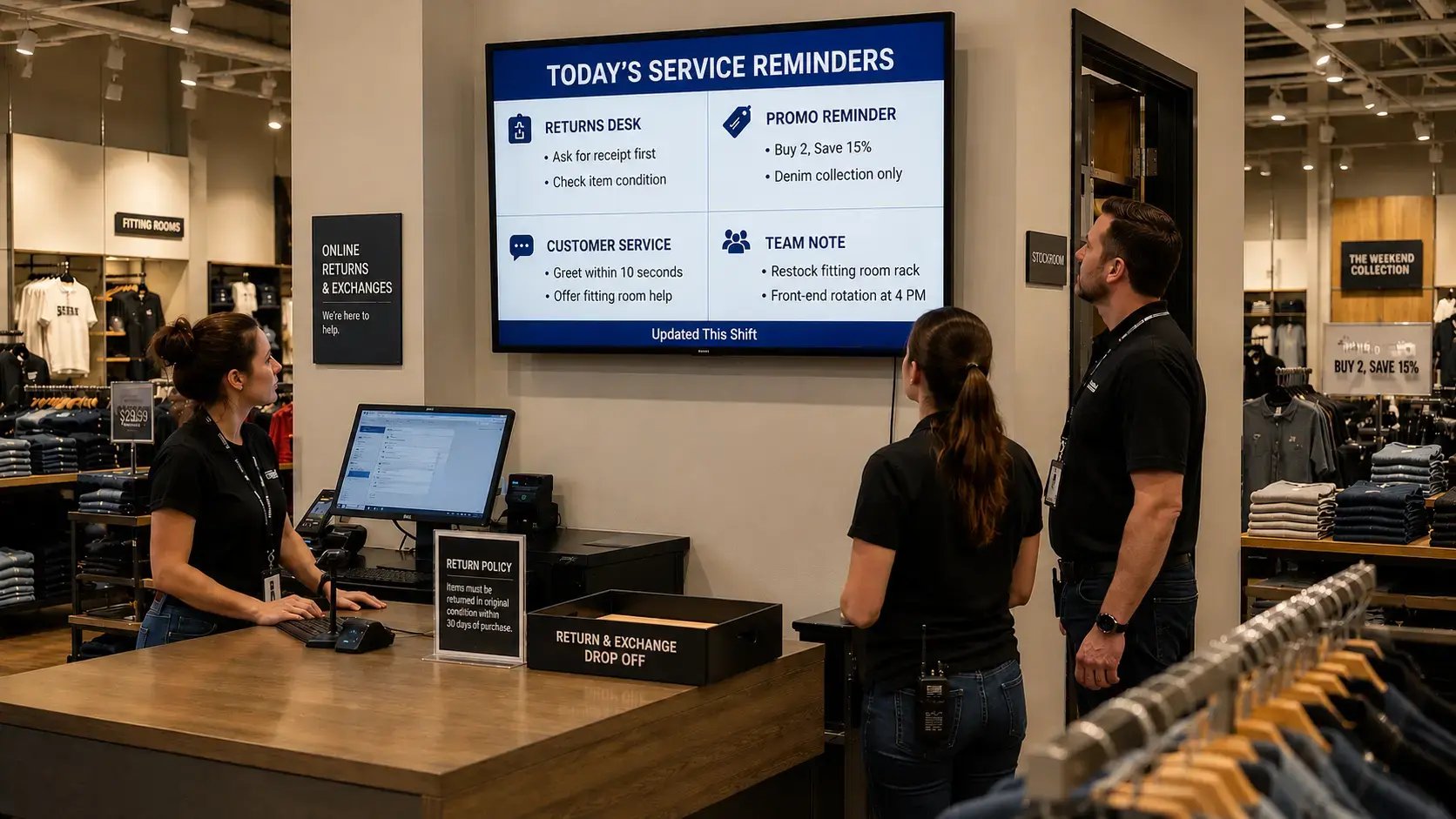
- Repetition at the point of work. Information needs to appear where and when it is relevant. A policy on how to handle a return is best absorbed at the returns desk, not in a training room two weeks earlier.
- Consistency across shifts and locations. A training message delivered by a morning manager to a morning team reaches half your staff. The other half - closing shifts, weekend crews, new additions - miss it entirely.
- Low friction for updates. Retail moves fast. Promotions change. Procedures update. A training infrastructure that requires printing, scheduling, and re-running sessions every time something changes will always lag behind the floor reality.
-
Visual and repeated exposure. Research from the Association for Talent Development consistently shows that spaced repetition - re-exposure to the same content over time - dramatically improves retention. A single training session provides one exposure. Retail digital signage provides it every shift.
Traditional Retail Employee Training vs. Retail Digital Signage
Here is how the two approaches compare across the dimensions that matter for a retail floor operation:
|
Factor |
Traditional Training |
With Retail Digital Signage |
|
Information retention |
Drops ~90% within a week (Ebbinghaus) |
Reinforced daily through visual repetition |
|
Coverage consistency |
Depends on manager delivering it |
Centrally controlled, same message everywhere |
|
Update speed |
Days to weeks (reprint, reschedule) |
Minutes - published centrally, live immediately |
|
Multi-location alignment |
Varies by store |
Identical content across all locations |
|
Cost of each refresh |
High - time, materials, scheduling |
Low - update once, deploy everywhere |
|
Training during peak periods |
Often skipped when floors are busy |
Always on, requires no floor management |
The gap is not minor. Every column represents a real operational problem that retail employee training programmes encounter regularly. Retail digital signage does not replace initial onboarding - it closes the gap between what happens in a training room and what actually sticks on the floor.
How Retail Digital Signage Supports Retail Employee Training: A Step-by-Step Approach
If you are building or improving retail employee training programmes with digital signage, this is the sequence that works consistently across the operations we have supported.
Step 1: Identify what gets forgotten first
Walk your floor and ask team members what they are least confident about. Promotions? Returns policy? Product placement standards? The answers tell you where reinforcement is most needed. Start there, not with everything at once.
Step 2: Map your physical touchpoints
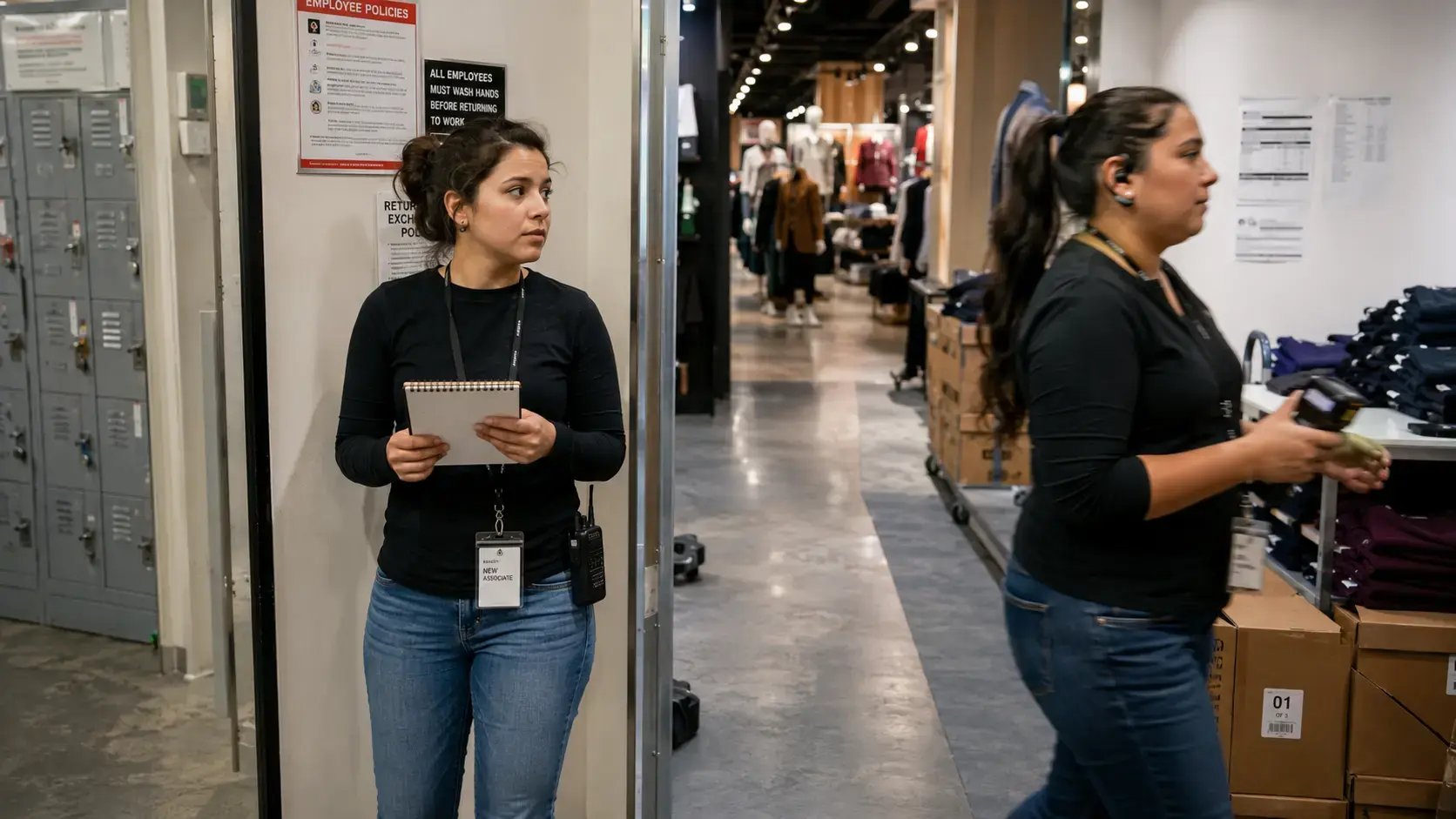
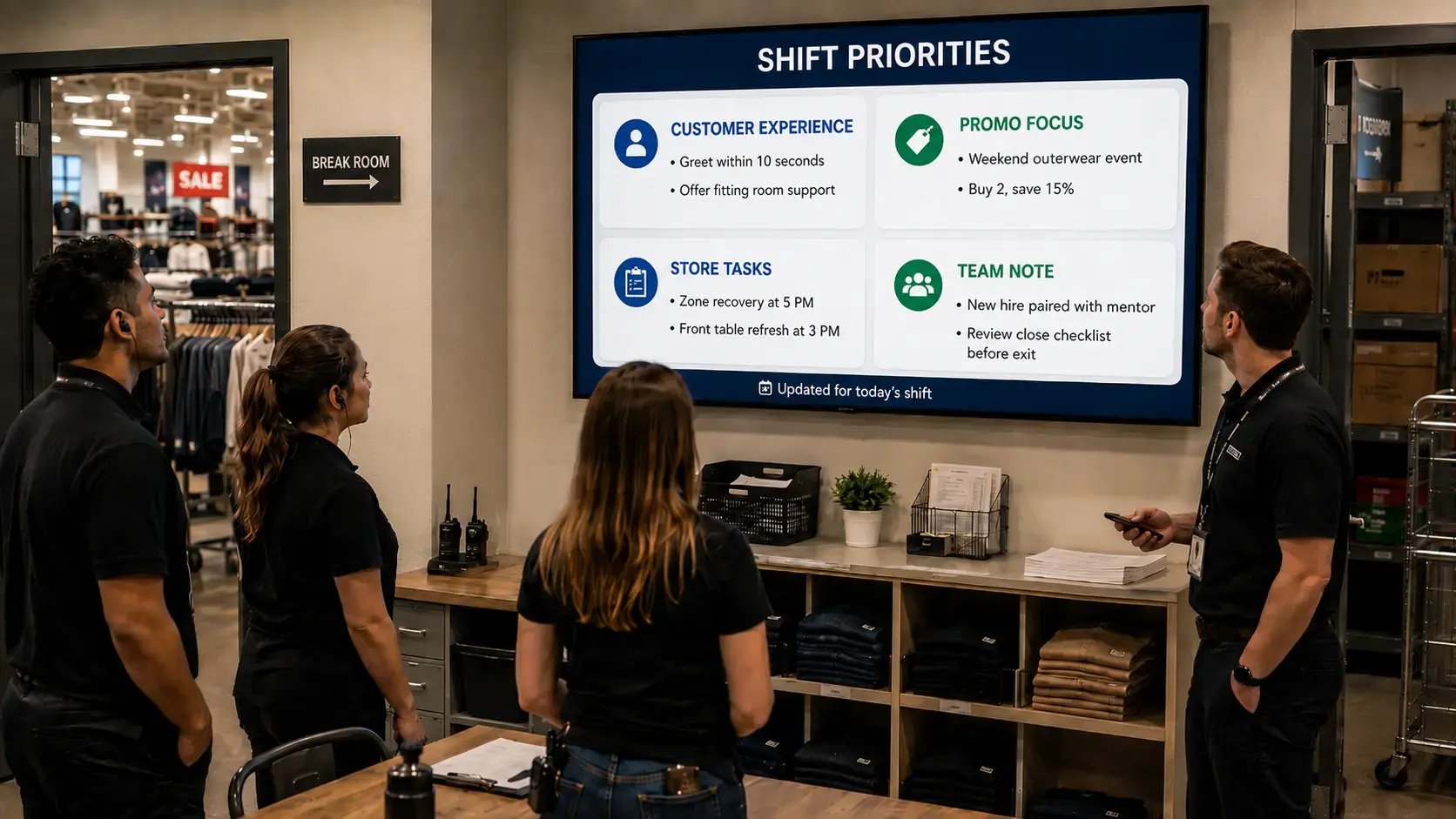
Where do staff spend their time before a shift starts, during breaks, and at key service moments? Staff entrances, break rooms, stockrooms, and service desks are the highest-value reinforcement points for retail digital signage. Each one is an opportunity for a brief, relevant reminder.
Step 3: Build content by role and zone
Not all staff need the same information at the same time. A stockroom team needs different reinforcement than a checkout team. Zone-specific retail digital signage allows you to surface content where it is relevant - product handling standards near receiving, service scripts near the floor, promotion details at the point of sale.
Step 4: Align signage content with your training calendar
If you run a product knowledge session on Tuesday, your retail digital signage should reinforce the top three takeaways for the next two weeks. Content should follow your training schedule, not run independently of it. The combination of a structured session followed by on-floor reinforcement is what actually changes behaviour.
Step 5: Build in review and refresh cycles
Retail employee training content on screens should update regularly - not because people get bored, but because the standards themselves change. Your digital signage platform should allow your training manager or operations lead to update content centrally without IT involvement. If they need a ticket to change a screen, the system will not be maintained.
What Changes After You Add Retail Digital Signage to Your Training Programme
The operational differences are measurable within the first month.
New hires reach competency faster because the floor is continuously reinforcing what they learned in onboarding. Managers spend less time answering repeat questions about procedures they have already explained. Shift consistency improves because the message on the screen is the same regardless of which manager is working.
For multi-location retailers, the impact is even more significant. Employee training for retail stores across multiple sites is notoriously inconsistent - different managers interpret things differently, different stores develop different habits. Centrally managed retail digital signage eliminates that variation. The same standard reaches every floor, every shift, every location.
Staff who feel continuously supported - who see that the organisation is actively communicating standards, not just demanding them - also report higher confidence in their roles. That confidence reduces the anxiety that contributes to early turnover.
Making Retail Employee Training Work Past Week One
The biggest investment in retail employee training is the first two weeks. Most of that investment is lost to the forgetting curve before it ever converts into consistent floor performance.
Retail digital signage is not a replacement for good training design. It is what makes the training you already have actually work at the floor level, past day one, consistently, across every shift and every location.
We help retail teams build display strategies that connect their training programmes to the floor in a way that sticks. If you want to see what that looks like for your operation, reach out to our team.

Frequently Asked Questions
What is the best way to structure retail employee training?
The most effective retail employee training programmes combine structured onboarding sessions with ongoing floor-level reinforcement. Initial training builds the foundation. Retail digital signage keeps it visible and relevant - surfacing key procedures, product knowledge, and standards at the point of work, every shift. One without the other produces short-term retention at best.
How does retail digital signage improve retail employee training outcomes?
Retail digital signage reinforces training content at the point of work, where and when it is most relevant. Instead of relying on employees to recall information from an onboarding session weeks earlier, centrally managed screens surface key reminders in stockrooms, break areas, and on the shop floor throughout every shift. This aligns directly with spaced repetition research - the evidence-based method for long-term knowledge retention.
How do you train retail staff consistently across multiple locations?
Consistent retail staff training across multiple locations requires centralized content management. With retail digital signage, your training manager publishes content once, and it appears on every screen at every location simultaneously. There is no variation by store manager and no lag between a procedure change and the floor knowing about it.
What should a retail employee training programme include?
Strong retail employee training programs cover product knowledge, service standards, compliance and safety procedures, promotional details, and location-specific operations. Retail digital signage extends each of these beyond the initial session - reinforcing the most important elements through daily visual exposure so the knowledge stays accessible when it is needed on the floor.
How long does it take new retail employees to reach full productivity?
Most new retail employees take between four and eight weeks to reach consistent floor performance. Employee training for retail stores that relies solely on initial onboarding takes the full range or longer. Programmes that add ongoing reinforcement through tools like retail digital signage typically see competency develop in three to four weeks - because the floor itself is doing part of the training work on every shift.
What are the main benefits of going paperless in manufacturing?
The main benefits: information accuracy (screens show current data, not last week's printout), faster updates (safety or production changes reach all screens within minutes), reduced supervisor overhead, compliance documentation (digital publishing creates an audit trail paper boards don't), and shift consistency (every shift sees the same information at the same time).

Brent Nacu
CRO at L Squared Digital
Brent Nacu is the Chief Revenue Officer at L Squared Digital, with 20+ years in digital signage. He helps organizations build display strategies that improve engagement, streamline operations, and drive real results.
LinkedIn